Features
- 12W combo amplifier
- Eminence 12” Special Design “CS” speaker
- Two 12AX7 preamp tubes; two 6V6 power tubes; single 5Y3 rectifier tube
- Fender Vintage “Blue” tone caps; Schumacher transformers
- Includes 1-button tremolo footswitch and Filson Rugged Twill fabric cover
Highlights
HAND-WIRED CIRCUITRY
This amplifier features hand-wired circuitry, mounted on eyelet board, performed by a builder at a workbench, just like the iconic Fender guitar amps of the 1950s and ’60s.
BROWN PRINCETON AMP
The sparkling cleans, rich overdrive and organic tremolo of Fender’s famous brown amps are prized by guitarists who know and appreciate unique tones.

12” SPECIAL DESIGN SPEAKER
Eminence speakers deliver versatile tone and performance spanning every sonic shade from clean to mean, and everything in between.

TUBE-BIASED TREMOLO
Rich, pulsating tremolo in any shade from subtle to stupendous is simply part of Fender’s guitar-amp DNA. Always has been and always will be.

SOLID PINE CABINET
Solid pine was a traditional Fender amp construction hallmark of the 1950s and ’60s, making for more resonant and more “musical” speaker cabinets.

FIRST COUNTRY SIGNATURE AMPLIFIER
Grammy-winner Chris Stapleton is one of the hottest country artists around the Nashville scene today, and we've gone to great lengths to replicate his favourite amp and tones.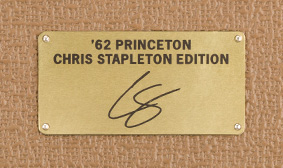
SPECIFICATIONS
Electronics
- Voltage: 240V AUS
- Wattage: 12 Watts
- Controls: Volume, Tone, Speed, Intensity
- Channels: One
- Inputs: Two - (1/4", Input 2 operates at -6dB)
- Speaker Jack: Two 1/4" Parallel (Internal and External)
- Effects: Tremolo
- Cabinet Material: Solid Pine
- Amplifier Covering: Brown Textured Vinyl
- Grille Cloth: Wheat
- Amplifier Jewel: Red Jewel
- Front Panel: Brown
- Handle: Vintage-Style Leather with Nickel Mounting Hardware
- Other Features: Classic 6G2 Circuit, Hand-Wired, Fender® Vintage “Blue” Tone Caps, Schumacher Transformers, Tube-Biased Tremolo, Solid Pine Cabinet, Engraved Brass Plate with Chris Stapleton's Signature.
- Legal Notice: WARNING: Cancer and Reproductive Harm - www.P65Warnings.ca.gov.
- Speakers: One - 12" Eminence® Special Design
- Total Impedance: 8 ohms
- Preamp Tubes: 2 x 12AX7
- Power Tubes: 2 x 6V6
- Rectifier: Tube (1 x 5Y3)
- Footswitch: 1-Button Footswitch Included
- Included Accessories: 1-Button Footswitch, Filson™ Heavy Fabric Cover
- Amp Height: 16" (40.6 cm)
- Amp Depth: 9.4" (23.88 cm)
- Amp Width: 18.9" (48.01 cm)
- Amp Weight: 33.25 lbs. (15.08 kg)
- 8151803000
- $3,899.00
Guitar Player
If an old-school-style Fender combo is calling out to you, don’t hesitate to pull the trigger on this one. Art Thompson Jun 11, 2019Based on a ’62 Princeton that country artist Chris Stapleton has been using for years, and which carries a 12-inch speaker in place of the original 10, this new signature edition follows suit by sporting a 12-inch Eminence speaker in a solid-pine cabinet. The hand-wired circuit also mirrors the original via dual 6V6 output tubes running in fixed bias (a novel feature for a small Fender amp in the early ’60s), combined with a split-phase “cathodyne” phase inverter, which afforded the 6G2 a little more grind at lower volumes than its bigger brother, the brownface 6G3 Deluxe. The CS Edition Princeton features Schumacher transformers and Fender vintage-style “blue” tone caps, and the workmanship, done entirely in California, makes for a sturdy amp that’s easy to service. The protective metal cage around the power tubes is the only reminder that we can never go back to the JFK era.
The ’62 Princeton also looks awesome with its brown textured vinyl covering, brown front panel with dark-brown radio knobs and a stitched-leather handle. There’s also a brass plate on the back with Stapleton’s signature. Weighing in at just 34 pounds and measuring 19 inches wide, 16.5 inches tall and nine inches deep, this amp is an ideal grab-and-go tube rig.
The increased heft of a 12-inch speaker is worth it, too, as the ’62 sounds deliciously full and complex whether played cleanly or wound up to where the output tubes add their own sweatiness to the distortion brew. And this amp gets very aggressive in an old-Marshall kind of stringy/presence-y way when the volume is up to five or higher. Badass! Tested with a Reverend Gristlemaster and a new Gibson Anniversary Les Paul, the ’62 Princeton responded equally well to single-coils and humbuckers and was super easy to dial in with just little tweaks of the volume and tone knobs. The amp is loud enough to keep up with bass and drums and is very sensitive and responsive to both picking attack and guitar-volume changes.
The tremolo is a grid-bias type that changes the bias on the output tubes, essentially turning them on and off to produce volume modulation. It delivers smooth organic pulse over a wide range of speeds and sounds so cool when the volume is up enough for some added growl. The ’62 Princeton has a great sense of dimension, so the lack of reverb isn’t an issue. That said, adding some spring-style ’verb from a Source Audio Ventris pedal sure added to the fun of playing it. Distortion boxes from Amptweaker, Danelectro and MXR also sounded excellent with the Princeton whenever higher gain tones were needed.
A soulful amp that is ideal for so many applications, the ’62 Princeton Chris Stapleton Edition has everything that makes the original so happening, and then some. Bottom line: If an old-school-style Fender combo is calling out to you, don’t hesitate to pull the trigger on this one.
KUDOS: A great sounding tube combo. 12" speaker is a welcome update
CONCERNS: None
Music Radar
None more brown
£1999 €2144 $1999 By Nick Guppy June 27, 2019
For many guitarists, the biggest stars of the vintage small valve-combo market are the Tweed and ‘Blackface’-era amplifiers made by Fender during the 50s and early 60s. That’s no surprise, of course, because since their introduction, Tweed and ‘Blackface’ Champs, Princetons and Deluxe's have been used by some of the world’s top players on stage and in the studio, producing many of rock’s all-time epic guitar tones.
But there’s more to Fender’s small amp heritage. Just under the radar but equally worthy are the blonde and ‘Brownface’ amplifiers made roughly between 1959 and 1963. This was a time of transition: the introduction of Tolex covering, forward-facing controls, twin channels, alternative loudspeakers and the new tremolo effect were all part of Fender’s drive to appeal to a wider range of players.
One of the most coveted amps from this period is the 6G2 ‘Brownface’ Princeton and Fender has just released a very special Custom Shop signature version of it, named for the multi-award-winning American country star Chris Stapleton.
Fender’s Custom Shop worked closely with Chris to arrive at what might be considered an idealised version of his prized originals. The Stapleton’s cabinet is made from lock-jointed pine boards for strength, lightness and resonance, expertly covered in brown Tolex, with the correct wheat speaker grille. Care has been taken to preserve original dimensions and corner radiuses, and the result is a seriously good-looking and very portable combo.
The electronics sit inside a traditional steel chassis, held firmly by four bolts in chrome strap washers. The circuit is built on an eyelet board, which is the traditional American method for valve amp building, where components are hand-soldered into strategically placed brass eyelets punched into a stiff fibre board. With a few small changes, the Stapleton’s parts and layout are very close to the original, including reproductions of the original blue Ajax coupling capacitors.
The build quality is first class, with Schumacher transformers, neatly routed wiring and perfect soldering. Our sample was the correct UK voltage but came with a moulded European Schuko plug on the end of a captive mains lead. There are grounded and non-grounded UK adaptors for this type of plug and it’s important to use the right one. We’d expect regular UK models to come with a three-pin UK plug, though.
The transition theme continues in the ’62 Princeton’s classic 6G2 circuit, which you could say sits halfway between a Tweed amp and the later ‘Blackface’ models - it has a fixed bias output stage, a cathodyne phase inverter and the famous ‘harmonic tremolo’ effect, using one half of a 12AX7 along with a few other components to modulate the output stage bias.
Controls are simple, like most Fenders from this era, with a pair of high- and low-gain input jacks feeding volume, tone, tremolo speed and intensity. One significant difference between the Stapleton and an original ’62 Princeton is the loudspeaker, which has been upgraded from the standard 10-inch to a special Eminence custom-design 12-inch. Overall, the Stapleton looks and smells right, even down to small details such as the engraved brass signature plate, leather carry handle and chrome strap washers.
Sounds The Princeton powers up smoothly with no need for a standby switch thanks to the 5Y3 rectifier, which ramps up voltages over a few seconds as opposed to the instant thump of silicon diodes. On pure all-valve circuits like this, it’s not unusual to hear a little hum while voltages stabilise, although once everything’s warmed up the Stapleton is practically free of hum and hiss.
Its clean sounds have exceptionally pleasing definition and detail, with a sweet yet bright top-end, alloyed with a balanced midrange and a punchy low-end, enhanced by the custom-designed 12-inch Eminence driver. Guitars are easy to dial in with the single tone control, which is just right for our Strat and Les Paul with the knob parked at around one o’clock. As the volume control is pushed past noon, the Princeton’s sumptuous cleans give way to a warm, punchy and very dynamic overdrive that gets thicker and more gained-out in the last quarter of the volume knob’s travel, without increasing the volume too much.
The Princeton’s tremolo effect is one of the things that make it so coveted. Linked to the output stage bias, the effect is ducked when you hit the strings hard, so single notes and chords don’t lose all of their attack. Far from simple volume up/down ramps, this tremolo is warm and lets the tone breathe. The speed range will suit most needs, although we felt it could have been moved down a little, with more range at the slow end.
There’s ample volume for smaller gigs thanks to the loudspeaker’s high sensitivity, with the best all-round sounds happening with the volume control on around two to three o’clock. The Stapleton is instant Americana in a box, generating authentic tones that sound as though they’ve been plucked straight out of 1960s Nashville, yet remaining very contemporary and versatile enough to cover many styles.
Signature models often include features that limit their wider appeal. However, where the Stapleton Edition is concerned, it’s practically identical to the original. Built with obvious respect, except for a few subtle circuit tweaks that enhance its character, and a superlative upgraded 12-inch loudspeaker, the Stapleton is perfect not just for home and studio but also small stages, where the high-sensitivity speaker makes the most of its 12-watt output.
As high-end boutique amplifiers go, it’s perhaps a little on the pricey side, but you get what you pay for and then some, as the outfit includes a unique heavy duty twill cover made by American outdoor apparel specialists Filson. Whether or not country music is your thing, Fender’s ’62 Princeton Chris Stapleton Edition is capable of sitting in many different musical genres, with one of the sweetest tones we’ve ever heard. Aimed at well-heeled amateurs, pro players and inevitably collectors, it’s a fitting tribute to Fender’s glory years and an amp that deserves to be heard.
- PROS: Superlative clean and natural overdrive tones, fabulous tremolo effect.
- CONS: A lot of money for a 12-watt valve combo, but in this case it’s not hard to justify.
SCORE: 4.5/5
Premier Guitar
Street: $1,999As much as the blackface Fender Princeton and Deluxe Reverb have become studio and club classics, plenty of players recognize the sweetness and magic of their café au lait brownface predecessors. Grammy Award-winning country artist Chris Stapleton is one of them, and his longtime use of a slightly modified, 57-year-old combo has inspired the release of the new Fender ’62 Princeton Chris Stapleton Edition.
With a totally hand-wired version of the classic 6G2 circuit and a vintage-accurate combo cab, this rendition of the Princeton replaces the original’s single 10" speaker with a beefier 12", which adds up to a surprisingly muscular performer in a relatively dainty package.
Compact Cutie
At a glance, it’s easy to write off the Princeton as the practice and student amp that Fender designed it to be back in 1961. The basic specs don’t dissuade you much from that assumption, either. With an output of 12 watts from two 6V6GT tubes and controls for just volume, tone, and tremolo speed and intensity—all housed in a compact combo cabinet measuring 19"x16"x9.5" and weighing 34 pounds—the Princeton doesn’t look like it’d be up to much other than basement, bedroom, or coffeehouse jams. That’s even with the addition of the 12" Eminence CS speaker with a ceramic magnet. But as many artists have found through the years, the Princeton’s size can be deceptive. Prepare to check your preconceptions at the door.While many amps of ’61–’63 hinted at the coming blackface models in terms of circuit evolution, the 6G2 Princeton truly marks a point between the smaller tweed combos of the ’50s and the blackface and silverface amps of the mid-to-late ’60s. With a simple front end driven by one 12AX7 preamp tube, a volume and tone control between the first gain stage and a second driver stage, and a cathodyne (aka split-lode) phase inverter that uses half of an additional 12AX7, the brownface Princeton follows the circuit of the legendary 5E3 tweed Deluxe pretty closely right up until the signal hits the output tubes, and we all know what those gnarly little combos can do.
The 6V6GTs in the 6G2 Princeton run at fixed-bias, so there’s a little more firmness in the output stage than is derived from the 5E3 Deluxe’s cathode-biased tubes. As a result, it doesn’t mush out as readily when pushed. The 5Y3 tube rectifier means there’s lots of tactile sensitivity and dynamics, but expect tighter-than-tweed response that accents twangy, chiming, or jazz tones at volume. The remaining half of that second 12AX7, meanwhile, is utilized in a simple tremolo circuit that’s one of the best sounding in an amp of this size. As a bias-modulating circuit acting directly on the output tubes (and selected via the included one-button footswitch), it’s lush, round, and warbly.
The brownface Princeton follows the circuit of the legendary 5E3 tweed Deluxe pretty closely, right up until the signal hits the output tubes, and we all know what those gnarly little combos can do.
Inside the chassis, Fender did a great job of replicating the handwired eyelet-board construction, while including updates necessitated by modern safety standards and production methods. Components, including the Schumacher transformers, are high quality. Outwardly, the ’62 Princeton looks so much like one of the originals—complete with finger-jointed solid-pine cabinet, tan Tolex, wheat grille cloth, ridged brown knobs, a brown control panel, and a leather handle—that you could easily mistake it for a vintage combo, until you looked around back to find 21st-century features like the safety cage around the tubes and a gold Chris Stapleton commemorative plaque.
Brown Sound
Tested with a 1957 Fender Telecaster and a Gibson 1958 Les Paul reissue, the Stapleton Princeton fast reveals itself as a wolf in sheep’s clothing. In short, Fender nailed it with this one. It sounds fantastic at all settings: authentically brownface, but with the fuller voice that a 12" speaker can lend to a circuit.It excels at crisp cleans that have a little extra grit and edge, compared to similar blackface-inspired combos. That also means juicy edge-of-breakup tones when you push the volume. Set the volume around noon with the Les Paul or 1 o’clock with the Telecaster, and you hear meaty, thick overdrive with clarity and perceptible harmonic bloom on top—a delectable output-stage-type distortion that lacks the thin fizz of many preamp-distortion-generating circuit designs. Add in the tasty tremolo, which is a truly sweet-sounding circuit, and the Stapleton is scrumptiously brimming with tone possibilities.
I’m also doubly impressed at the relative openness of the sounds from this little combo. Many smaller cabs intended for single 10" speakers can sound boxy, nasal, and constricted when stuffed with a larger 12", but there’s none of that here. Note, too, that this a surprisingly loud amp for its size and rating, so you might want to use an output attenuator if you require maxed-out crunch and lead tones at neighbor-friendly (or even smaller club) volumes. That said, it handled a TS9 Tube Screamer and a Bogner Wessex overdrive beautifully during testing, so good sounding overdrive doesn’t have to inevitably summon the noise police.
The Verdict
Brownface combo circuits have been popular among boutique builders recently, but there’s certainly something very time-travel-cool about hearing real brownface tone and experiencing such high quality in an amp with the Fender nameplate on the grille. The ’62 Princeton Chris Stapleton Edition is an impressively proud and punchy little combo, with a bellowing, complex voice and muscularity that belies its size and power rating. And while it might be a bit pricey for its size for some players, there’s little to fault in the execution either inside or out.Ratings
Pros: An accurate, authentic sounding, and well-constructed brownface Princeton combo, with the bonus of a 12" speaker for a surprisingly big, rich, meaty voice.Cons: A touch expensive. Some bedroom players will still need to use an output attenuator to achieve lower-volume overdrive tones—even at 12 watts.
- Tones: 4.5/5
- Ease of Use: 5/5
- Build/Design: 4.5/5
- Value: 5/5

