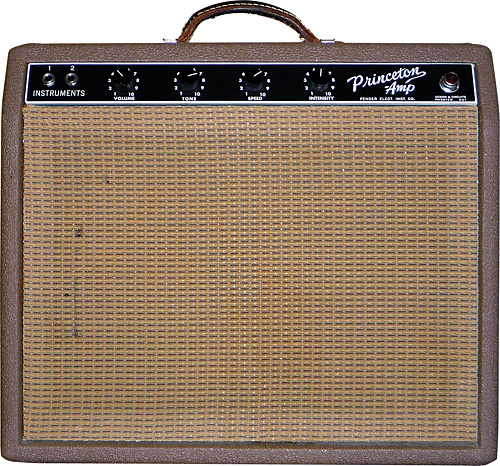
- Preamp tubes: One 7025, one 12AX7
- Output tubes: two 6V6GT in fixed bias
- Rectifier: 5Y3
- Controls: Volume, Tone, Speed, Intensity
- Speaker: one 10” Oxford 10J4
- Output: approximately 12 watts RMS
While it isn’t always entirely accurate to describe the brownface/tan-Tolex amps of 1960-’63 as “somewhere between a tweed and a blackface,” this ’62 Princeton fits that billing rather well. In this case, though, the 6G2 Princeton circuit is perhaps closer to the 5E3 Deluxe in several ways (including tone) than it is to its single-ended tweed forebear, or it would be if not for its rather underpowered 10″ speaker.
In 1960, the Princeton went from being the larger of the beginner’s bedroom amps in the Fender lineup to being the smaller of the performance amps. With two 6V6GT output tubes in push/pull fixed bias for a robust 12 watts, it was suddenly too loud for the average kid’s bedroom, but graduated successfully to the basement or garage, where it could hit the sweet spot perfectly with a couple pals on drums and bass. This is the status the brown Princeton maintained for many years – underrated as a performance amp compared to the versatile Princeton Reverb, long a studio favorite of many pros – and it’s a situation for which any player likely to have acquired one lately can be thankful. Like our example here, many 6G2 Princetons exist in outstanding original condition, having seen only light duty for a few years, then a quiet life in the closet, awaiting eventual rediscovery and a second coming as an unassuming little tone monster. And that she is. While the 6G2 packs plenty of snappy chime and twang at lower settings on the Volume dial, anything in the noon to 2 o’clock region reveals toothsome growl and snarl, and settings up into late afternoon unveils a surprisingly gutsy roar.
The 6G2 Princeton’s fixed-bias output stage takes it out of the nominal-class-A camp of the cathode-biased tweed Deluxe and the like, but its cathodyne inverter (a.k.a. split-phase inverter) puts it in sort of two-steps-forward, one-step-back situation. With this PI configuration, it will never have the clarity and fidelity to make it merely “a smaller brown 6G3 Deluxe,” a definition its specs might otherwise imply, but will instead offer a certain grit and swagger in its tonal signature, even at cleaner settings, with some voices that do at least tip their hat to the 5E3.
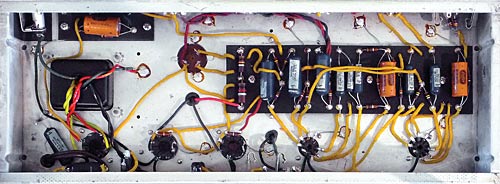
Like Fender’s big boys of the early ’60s, the little 6G2 Princeton was also a fixed-bias amp – a status flagged by the bias circuit rendered on its own little board in the upper-left corner of the chassis. The immaculate condition of this example and the presence of all those lovely blue “molded” Mallory signal caps make it a great, yet affordable, find.
The 6G2’s 5Y3 rectifier tube also keeps this amp tweedily brown, providing just around 315 volts DC on the plates of the 6V6s (though often a little more with today’s higher domestic AC line voltages). That, coupled with readings of around 135 volts DC on the plates of the first triode of the 7025 (a.k.a. 12AX7) in the front end, the lone gain stage in the Princeton’s preamp if you exclude the front half of the PI, makes for a chewy, tactile playing feel that can come off as being a lot more touch-sensitive than many larger brown amps and later blackface amps. A leap to the top of the ladder in the rectifier stakes would give the blackface AA964 Princeton a GZ34 rectifier and a whopping 420 volts DC on the plates of the 6V6s (a 5U4GB and 410 volts DC in the AA1164 Princeton Reverb), and while the cathodyne PI meant these models retained some signature bite, they were also a little crisper and more aggressive.
It’s a bit surprising that Fender went to fixed bias at all for the 6G2, but one of this amp’s other standout features offers a clue to the thinking behind this move. Other than the first-generation tweed Tremolux, the 5G9 and 5G9-A, Fender always preferred to mount its bias-modulated tremolo circuit on a fixed-bias output stage. This was, perhaps, for reasons of output-tube stability, although other designs have functioned smoothly with bias-wiggle tremolo acting on cathode-biased output tubes. Either way, this preference saw the Princeton upgraded to fixed-bias, and other than the single-ended Champ there was no longer a cathode-biased amp in the Fender line.
Whatever the thinking, this tremolo is an utter joy, and we can thank Leo for doing it this way. While players often rave about the lush, deep “harmonic vibrato” of the bigger early brown amps, such as the 6G4 Super (as discussed in the October ’10 issue of VG – wouldn’t they make a sweet pair?), the tremolo on the 6G2 Princeton is achieved with just half a 12AX7 and a mere handful of caps and resistors. As simple as it is, however, it modulates the output tubes in a smooth, organic manner that sounds utterly dreamy, providing one of the most evocative tremolo effects around (the harmonic vibrato of the larger brown amps is undoubtedly impressive, but sometimes you just want pure volume-modulating tremololike our Princeton carries, not the wetter warble of the Super, Pro, or Concert). As with many bias-modulated tremolos, it’s a very playable effect, too; hit the strings hard and it steps aside so your note attack pops out proudly – allowing you to solo without switching out the effect – then makes itself known again as it throbs back into action on the decay of the note.
All in all, with its bumped-up specs and gutsier tone, the 6G2 Princeton can still find itself stuck between two stools; is it a club amp with an underpowered speaker, or a practice amp with an overpowered output stage? Make one simple change and it can be neither – and both – if you catch our drift. As sweet as the original 10″ Oxford 10J4 speaker can sound in this amp, a decent 12″ (or even a more robust 10″) makes a big difference. If you want that bigger driver right in the amp, please don’t hack a bigger hole in the original baffle; good and authentic-looking replacement baffles with 12″ cut-outs are readily available. Alternatively, use this little sweety as a “head” perched on top of the 8-ohm cab of your choice to reduce the inherent “boxiness” in the smaller combo cab. Bedroom amp? Hah! They won’t be laughing for long.
Owner 6G2 Review
The brown 6G2 Princeton Amp is often described as sitting somewhere between Tweed and Blackface Fenders - both sonically and of course chronologically. However, it does have a voice of its own: for instance, it has significantly more midrange roar than the Blackface era amps - actually it sounds very angry indeed when pushed hard. It also won't sag as much as the cathode-biased 5E3 Deluxe when you hit the low strings hard. My amp has been recapped and the original handle has been replaced first with a no-name strap and recently with a genuine current-production Fender leather handle. The tremolo footswitch is missing, but otherwise there's little to complain about.
The brown Fenders weren't that popular in the past while everyone was after the Tweed and Blackface era amps. Lately, however, they have started to get the recognition they definitely deserve. The lack of "mainstream success" until recently has one definite upside: these early 60's tone machines can be found in astoundingly good condition - most of them having been lying in garages, attics or storage rooms for decades while their black and Tweed counterparts were being lugged all over the world. I'm not saying mine is an example of a museum piece, but realizing it's a 50-year old piece of musical gear, I've seen worse. Much worse.
As far as official sources go, there is no such thing as 6G2-A. There's a hand-written "A" on the tube chart of this amp, but I doubt it is a sign of a revised schematic as the last Princetons of this era were manufactured in 1964 and there's no sign of a "-A" suffix in those amps - or any other suffix for that matter. All "6G2-A" Princetons seem to have been made in early 1962. In discussion forums people have found one common denominator to most (if not all) 6G2-A amps (or whatever you wish to call them): they have an Alnico Oxford 10JB-14 speaker instead of the much more common ceramic Oxford 10J-4. This has led to one plausible theory: maybe the "A" implies Alnico speaker. Who knows? At least there are several examples and mine is one of them.
The tremolo in this amp is downright delicious. It's not the pitch-shift-warble kind of thing that a Fender Bandmaster and several other amps of the same era have. While that lush chorusy vibrato is fantastic, sometimes you'll want something that can actually be called simply a tremolo: that is, a fluctuation of the volume rather than pitch. This amp does it exactly the way I want a tremolo to be: it's strong - almost hypnotizing at extreme settings - yet it kind of steps away especially when playing lead parts with percussive, fast notes. Theoretically you could leave it on all the time if you just want to spice sustaining notes and chords with it and otherwise play staccato melody lines... to a certain degree of course. One interesting thing is that the Brownface Princeton has almost exactly the same circuit as the Tweed Vibrolux - another classic Fender amp.
This amp has been fully seviced in November 2012:
The brown Fenders weren't that popular in the past while everyone was after the Tweed and Blackface era amps. Lately, however, they have started to get the recognition they definitely deserve. The lack of "mainstream success" until recently has one definite upside: these early 60's tone machines can be found in astoundingly good condition - most of them having been lying in garages, attics or storage rooms for decades while their black and Tweed counterparts were being lugged all over the world. I'm not saying mine is an example of a museum piece, but realizing it's a 50-year old piece of musical gear, I've seen worse. Much worse.
As far as official sources go, there is no such thing as 6G2-A. There's a hand-written "A" on the tube chart of this amp, but I doubt it is a sign of a revised schematic as the last Princetons of this era were manufactured in 1964 and there's no sign of a "-A" suffix in those amps - or any other suffix for that matter. All "6G2-A" Princetons seem to have been made in early 1962. In discussion forums people have found one common denominator to most (if not all) 6G2-A amps (or whatever you wish to call them): they have an Alnico Oxford 10JB-14 speaker instead of the much more common ceramic Oxford 10J-4. This has led to one plausible theory: maybe the "A" implies Alnico speaker. Who knows? At least there are several examples and mine is one of them.
The tremolo in this amp is downright delicious. It's not the pitch-shift-warble kind of thing that a Fender Bandmaster and several other amps of the same era have. While that lush chorusy vibrato is fantastic, sometimes you'll want something that can actually be called simply a tremolo: that is, a fluctuation of the volume rather than pitch. This amp does it exactly the way I want a tremolo to be: it's strong - almost hypnotizing at extreme settings - yet it kind of steps away especially when playing lead parts with percussive, fast notes. Theoretically you could leave it on all the time if you just want to spice sustaining notes and chords with it and otherwise play staccato melody lines... to a certain degree of course. One interesting thing is that the Brownface Princeton has almost exactly the same circuit as the Tweed Vibrolux - another classic Fender amp.
This amp has been fully seviced in November 2012:
- new Hammond 290AEX power transformer to accept European 230V voltage
- new power cord with a Schuko connector
- worn-out components replaced in the bias circuit: electolytic capacitor + diode
- 10k ohm bias trimmer installed
- ground switch disconnected (no use for it in Europe)
Specifications
- Model: Princeton
- Model No: 6G2
- Config: Combo
- Control Panel: Brown, forward facing w/ white screened labels, controls numbered 1-10
- Front Control Layout: In, In, Volume, Tone, Speed, Intensity - Pilot Lamp
- Rear Control Layout: Ground Switch, Fuse (2A), Power Switch, Speaker Jack, External Speaker Jack, Tremolo footswitch
- Knobs: Brown round
- Dimensions: 16½" x 19" x 9½" (41.9 x 48.3 x 22.9 cm)
- Weight: 10 kg (22 lbs)
- Cab Hardware: Leather handle (current-production), 4½" chassis straps, glides
- Cab Covering: Brown Tolex
- Grille: Wheat grille cloth
- Logo: none
- Speakers/Load: 1 x 10" / 8 ohms
- Speaker Model: Oxford 10JB-14 Alnico
- Effects: Tremolo
- Footswitch: missing
- Output: 12 Watts
- Preamp: 7025
- Power: 2 x 6V6GT
- Bias: Fixed, nonadjustable
- Rectifier: 5Y3GT
- Phase Inverter: ½ 12AX7 (split load, also known as "cathodyne" or "concertina")
- Mains transformer: currently a Hammond 290AEX that accepts European voltage (naturally I also have the original Schumacher)
- Output transformer: Schumacher
- Other: Tremolo: ½ 12AX7 (bias vary)
- Tube configuration
- V1: preamp
- V2A: tremolo oscillator
- V2B: split-load phase inverter
- V3, V4: output tubes
- V5: rectifier
- Serial numbers:
- Chassis: P01560
- Tube chart: LA (January 1962), Production #6, "A" hand-written after "6G2"
- Mains transformer: 125P1A, 606146 (1961, week 46)
- Output transformer: 125A10B, 606204 (1962, week 4)
- Speaker: 465-133 (magnet) - denoting Oxford, 1961, week 33; P4474-1 (speaker cone)
The History of the Fender Princeton Amp (Carl's Amps)
Part I: The Early Years Woody and Tweeds
The Princeton amp has been around almost since Fender's inception. The Princeton haas remained a popular amp in Fender's line. Over the years the Princeton has undergone many circuit and cosmetic changes. For the purposes of our discussion we will only consider the classic Princetons made from 1946 to 1981. This covers the Woody Princetons, Tweeds, Brownface, Blackface and Silverface Princetons. These are the quintessential years for the Fender Princeton that most interest players and collectors. I will briefly discuss the Princeton models, circuits, sounds and basic modifications.
Note on Early Models:
All these early Princeton models are 5 watt cathode biased amps (no need to bias these when changing tubes). They were intended for students rather than professionals. All models use 5Y3 rectifier tubes but a GZ-34 or 5V4 can be substituted for more punch and volume. All models came with 8 inch Alnico Speakers but these amp sound much bigger with larger speakers.
The Woody Princeton, TV Front Princeton and 5B2 Wide Panel Princeton 1946-1953:
All three of these models used the same cicuit but had different cosmetics. The tube setup was a 5Y3, 6V6, and a 6SL7 for about 5 watts of power into a 8 inch Alinco Speaker. These amps had a high and low input and Volume and Tone Controls. This version of the Princeton used a grid leak biased first gain stage giving the sound a distinctive grit and brightness but making it unsafe to use higher gain pedals with (why would you want too?). The 6Sl7 has a fat, jangly and gritty quality that really make these amps sing.
The power section is flawed in these amps. Increasing the filtering and some other slight changes can great reduce hum and increase punch. Adding a 3 prong grounded cord is a necessity. I also recommend adding 2 watt 1K screen resistor and replacing filter caps over 10 years old for the best sound.
Wide Panel 5C2 1954-55
These amps are very similar to the the early models with two exceptions. They use 6SC7 rather than 6SL7 which are very similar tubes. The 5C2 uses a cathode biased first gain stage allowing for better headroom and slightly more refined sound. This is the model that inspired my Octal Princeton that garners rave reviews and can use 6V6 or 5881 power tubes and has 12" speaker.
Again the power section is flawed in these amps and uses the configuration as the previous model. Increasing the filtering and some other slight changes can great reduce hum and increase punch. Adding a 3 prong grounded cord is a necessity. I also recommend adding 2 watt 1K screen resistor and replacing filter caps over 10 years old for the best sound.
Wide Panel 5D2 1955
This the first Princeton to use the 12AX7 rather than the 6SL7 or 6SC7 of previous models. Fender went back to a grid leak biased first gain stage giving the amp a gritty sound. This is rare one.
Again the power section is flawed in these amps and uses a similar configuration as the octal models. Increasing the filtering and some other slight changes can great reduce hum and increase punch. Adding a 3 prong grounded cord is a necessity. I also recommend adding 2 watt 1K screen resistor and replacing filter caps over 10 years old for the best sound.
Narrow Panel 5E2 and 5F2 1955-56
These rare versions were made with a cathode biased first gain stage. They also introduced negative feedback which gave them a smoother more even sound. Both used a choke transformer in the power section with rather minimal filtering. So additional filtering is helpful here to give amp punch and reduce hum. Adding a 3 prong grounded cord is a necessity. I also recommend adding 2 watt 1K screen resistor and replacing filter caps over 10 years old for the best sound.
Narrow Panel 5F2A 1957-60
This is the classic Tweed Princeton model. Fender improved the power section with better filtering and dropped the choke giving the amp more punch, volume and definition. Again it has a 12AX7, 6V6 and 5Y3 as it's tube compliment. The 12AX7 is cathode biased and the sound is clear at lower volumes and get a nice crunch when turned up. This is model people are generally referring to when they talk about a Tweed Princeton.
Adding a 3 prong grounded cord is a necessity. I also recommend adding 2 watt 1K screen resistor and replacing filter caps over 10 years old for the best sound.
The Brown Princeton is favorite of mine and has great cleans but the overdrive is accessible and tremendously pleasing. The bais wiggle trem is a real treat for the ears and gives a nice soft tremolo.
Features:
Volume, Tone, Speed and Depth Controls, 15 Watts, two 6V6, Two 12AX7 and one 5Y3, 10 inch speaker.
Flaws:
Brownface Princeton 6G2 1961-1963
The Brownface Princeton represented a big change for the Princeton line and many these changes remained through the Blackface and Silverface years. The Brownface was a 15W amp with tremolo bias wiggle on-board. Additionally it was fitted with larger 10 inch speaker and was the first fixed bias Princeton. This design used a cathodyne phase inverter which is circuit that was found in 5E3 Tweed Deluxe and many other amps of day. However by the Brownface years the Princeton was the only Fender amp that used the cathodyne phase inverter circuit. In truth the Brownface wasn't a new design but rather a updated version of the 5F11 Tweed Tremolux.The Brown Princeton is favorite of mine and has great cleans but the overdrive is accessible and tremendously pleasing. The bais wiggle trem is a real treat for the ears and gives a nice soft tremolo.
Features:
Volume, Tone, Speed and Depth Controls, 15 Watts, two 6V6, Two 12AX7 and one 5Y3, 10 inch speaker.
Flaws:
- A. Fender cheap-ed out and didn't use screen resistors. Adding 1K 2 watt units is good idea.
- B. The bias is non-adjustable. Adding bias pot is really helpful to getting the best sounds from the amp and keep the tubes safe.
- C. Adding a three prong grounded cord is a must!
- D. The amp uses a single can cap for all the filters caps which leads to grounding issues. It's quieter with a separate ground for the filter caps so when re-capping I suggest installing a separate caps.

