The original and famous honey-toned beauty since 1960! Part of the Historic Collection. Handcrafted in: Bozeman, MT.
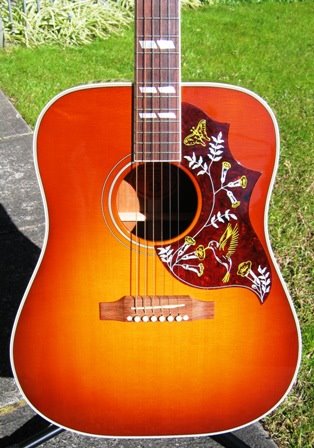 |
The Gibson Hummingbird is an acoustic guitar model produced by the Gibson Guitar Corporation. Unlike the other flat-top Gibson acoustics, the Hummingbird was Gibson's first square-shoulder dreadnought, similar to the dreadnoughts produced by C.F. Martin & Company. Introduced in 1960, the Hummingbird was Gibson's second-most expensive acoustic guitar, behind the Gibson J-200, until the introduction of the Gibson Dove in 1962, (a blend between the Hummingbird and the J-200.) The Hummingbird features a Mahogany back and sides, a decorative pickguard with a hummingbird design, and split-parallelogram Mother of Pearl fretboard and headstock inlays, Spruce top and Rosewood bridge.
The standard finish is cherry sunburst, although some natural finish models were produced. The Gibson Hummingbird was winner of Guitar Magazine's Player's Choice Award for the Dreadnought Category in 2000, and was described thus: "The Hummingbird has a very wide range of sound, from gutsy and loud, to sweet and soft. Superb for all styles of playing, whether just chording or playing intricate solo's". Keith Richards has used Hummingbirds quite frequently throughout his career, alongside other acoustic guitars. His Hummingbird can be heard in many Rolling Stones songs, such as "Let it Bleed", "Love in Vain", "No Expectations", and "Dead Flowers". Other notable Hummingbird players include Brian Jones, Sheryl Crow, Sarah Harmer, Mick Jagger, Alan Sparhawk, John McLaughlin, Gram Parsons, Lefty Frizzell and currently Michelle Branch is using one.

The standard finish is cherry sunburst, although some natural finish models were produced. The Gibson Hummingbird was winner of Guitar Magazine's Player's Choice Award for the Dreadnought Category in 2000, and was described thus: "The Hummingbird has a very wide range of sound, from gutsy and loud, to sweet and soft. Superb for all styles of playing, whether just chording or playing intricate solo's". Keith Richards has used Hummingbirds quite frequently throughout his career, alongside other acoustic guitars. His Hummingbird can be heard in many Rolling Stones songs, such as "Let it Bleed", "Love in Vain", "No Expectations", and "Dead Flowers". Other notable Hummingbird players include Brian Jones, Sheryl Crow, Sarah Harmer, Mick Jagger, Alan Sparhawk, John McLaughlin, Gram Parsons, Lefty Frizzell and currently Michelle Branch is using one.
Sound: 9
Many people reckon the original 60's guitar sound better than the current one. It sounds so good now, I'll just have to wait 40 years to see if there is any comparison. All I can say is, this is the best acoustic guitar I have ever played.
Action, Fit & Finish: 9
Looks fantastic. Finish and quality are outstanding. Reliability/Durability: ? Who can say? It's well made but too early to say about the reliability.
Overall Rating: 9
I predicted that I would get a Gibson Hummingbird when I was struck by Guitar Acquisition Syndrome in 2003. It was was the only acoustic guitar I've ever wanted. Being into electric guitars, I imagined that I would pickup the 'bird when I couldn't or wouldn't (be bothered) to set up my electric rig. But I never thought thought I would like it so much. I now understand how people could get into acoustic guitars. I now go for the bird all the time. It is easy guitar to play for hours, stays in tune and sounds great. I might even be in the market for a dove one day.Features: 9
My guitar made in Bozeman during 2004. It's an faithful reproduction of the original 1960's hummingbird. The Montana Gibsons are very well regarded as bringing quality back to the Gibson acoustic range.FINISH
Heritage Cherry Sunburst
BODY
Body Style: Square Shoulder DreadnoughtTop Species: Solid Premium Sitka SpruceBack and Sides: Solid MahoganyBody Binding: 6-ply top, 4-ply backTop Wood Solid SpruceUpper Bout: 11-13/16"Lower Bout: 16"Body Length: 19-13/16Body Depth Head: 3-11/16"Body Depth Tail: 4-3/4"
NECK
Species: MahoganyScale: 24-3/4"Profile: RoundFINGERBOARDSpecies: Indian RosewoodBinding: single-plyInlays: MOP ParallelogramsNut Width: 1.725
Other Inlays: MOP Crown on headsets

BRIDGE
Bridge: Traditional Gibson Rosewood BridgeBridge Inlay: MOP DotsBridge Style Top BellyPins: White
HARDWARE
Tuners: Nickel Grover KidneyPickguard: Tortoise HummingbirdPickups: Active Preamp
OTHER
Case: Premium Hardshell
Strings: Gibson Masterbuilt Premium Phosphor Bronze Wound
Gibson hummingbird guitars were Gibson's first square shoulder dreadnought guitars, although the guitar was a little pricy when it was introduced in 1960 it was an immediate success. The Hummingbird was and is an eye catcher and plays acceptionally well (rich tone), it opened and paved the way for other household named flat top gibson acoustic guitars with square shoulders such as the dove custom guitar, country western and the gibson heritage. Many collectors debate on whether this guitar is truly collectible because of its square shoulders, in my opinion the hummingbird is a significant part of Gibsons' history and according to the trend its vintage price value keeps on going up year after year. In 1960 the hummingbird was 16.25" wide, it had a rosewood bridge, mahogany body back and sides, engraved hummingbird on pickguard, bound body and neck, gold tuners, double parallelagram fingerboard inlays, and were made in cherry sunburst. From 1960 till present there was no drastic changes to the hummingbird accept for minor changes. In 1963 some hummingbirds were made with maple back and sides (which was optional), and pickguards were a little smaller, in 1965 gibson added humminbirds made in natural finishes, some pickguards were attached with screws in late 60s. In 1970 the hummingbird had non adjustable bridge saddles, and a 3 piece mahogany neck. In 73 they started making them with block inlays on the fingerboard, during the early 80s parallelagram fingerboard inlays were reintroduced. In 1985 they made a 90th anniversary Vintage Hummingbird.
Guitar Price Value:
Guitar Price Value:
1960 - 1962 > $3500 to $4500 ( maple back and sides optional )1963 - 1964 > $3000 to $4000 ( 2700 shipped )1965 - 1968 > $2500 to $3500 ( natural finishes were added in 65 )1969 - 1983 > $1500 to $25001984 - 2004 > $1200 to $1800 ( A 90th anniversary was introduced in 1985 )
Guitar price guide:
1960 - 1962 > Avg Upward Trend Of 20% a Year since 20001963-1964 > 11%1965-1968 > 8%1969-1983 > 12%1984 - 1999 > 5% Hummingbird Flattop
Available:
1960 to present Collectibility
Rating:
1960-1965: C-, 1965-1969: D-
Because this is a square shoulder guitar, there aren't a lot of collectors interested in this model, even though it was Gibson's second most expensive flat top (only behind the J-200).
- 1960 Hummingbird (introduction) specs: 16.25" wide, Gibson's first square shoulder dreadnought, mahogany back and sides (often the side was laminated), adjustable saddle on the rosewood top belly bridge, 3-ply maple bridge plate, single "X" braced spruce top, pickguard with 2 points on upper treble bout and 1 point level with bridge, engraved hummingbird on pickguard, multiple bound top, bound fingerboard with double parallelogram inlays, 24.75" scale mahogany neck, crown peghead inlay, gold tuners, cherry sunburst finish.
- 1962, 1963 Hummingbird specs: Some with maple back and sides, $250 list price.
- 1963 Hummingbird specs: Natural top finish with cherry back and sides optional. Pickguard slightly reduced in size.
- 1965 Hummingbird specs: The sides around the neck and at the end pin sometimes painted black. This hides where Gibson over-sanded the body, and sanded through the top layer of the mahogany laminated side!
- 1968 Hummingbird specs: Bottom belly bridge that is more squarish, some with tobacco sunburst, some pickguards attached with screws.
- 1969 Hummingbird specs: Bracing changed to be large and bulky, with tone suffering.
- 1970 Hummingbird specs: Non-adjustable bridge saddle, laminate 3 piece mahogany neck.
- 1971 Hummingbird specs: Double "X" bracing used.
- 1973 Hummingbird specs: Block fingerboard inlays.
- 1984 Hummingbird specs: Back to double parallelogram fingerboard inlays.

