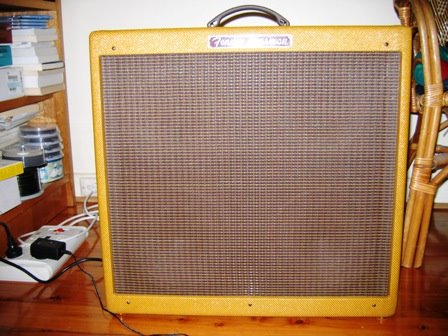
The modern update to one of the greatest guitar amps ever made. The mighty 4x10" Bassman began life as a bass amp before guitar players discovered its sonic wonders and adopted it as their own. Prized by guitarists everywhere for more than half a century now, it lives on as a must-have guitar amp treasured for its pure sound, workhorse reliability, classic style and uncluttered ease of use. Countless guitar players have rediscovered the great simple pleasure of plugging into this amp, and today's '59 Bassman® LTD delivers wide stage coverage, touch-sensitive dynamics and full-frequency tone that make it perfect for building great sound with any guitar and effect. A Fender classic then and now.

The ’50s Fender Bassman was the pro bassist’s answer to amplifying a great new invention: the Fender Precision Bass® guitar. This powerful 50-watt rig could easily compete with the common instrumentation of the day: horns, piano, four-piece drum kit with calfskin heads, and maybe even an electric guitar through a nice, new 10-watt amp! By the ’60s and ’70s, the original all-tube “Tweed” 4x10 Bassman was popular with rock, country and blues guitarists as a reliably great-sounding and easy-to-use guitar amp. Even some emerging British amp designers of the day copied its circuitry for use in their most celebrated designs.
In the 1990s, Fender released an affordable reissue of the now-collectible ’59 Bassman amplifier to massive acclaim. Many guitarists, tired of experimenting with preamps, equalisers, and effects racks, rediscovered the simple pleasure of plugging into a Fender tube amp. The Bassman’s wide stage coverage, touch-sensitive dynamics and full-frequency “swirl” make it the perfect vehicle for building a great tone with almost any guitar or effect. The reissue Bassman continues to be a staple of the Fender guitar amp line to this day.
TUBE CIRCUITRY
Simply put, there’s really nothing quite like the pure, powerful sound of a Fender tube amplifier. For decades, the tonal richness and touch-sensitive dynamics of real tubes have given Fender amps a defining and unmistakable voice, as heard on most professional recordings and performances of the past 60 years—the music you’ve known your whole life.
CLASSIC TWEED TONE
Heard on countless recordings since the 1950s, this is the timeless guitar amp tone of the original-era tweed-covered Fender amps and their tweed descendants from every decade since, with remarkable touch sensitivity and sound that really comes alive when cranked.
ASSEMBLED IN THE U.S.A.
Just like the great Fender guitar amps of the 1950s and ’60s that founded our amp legacy and defined the essence of pure tone and power, this amplifier is assembled in the United States.
TWEED COVERING
For a timeless air of vintage-style authenticity straight from the original 1950s golden age of Fender amps, this amplifier is smartly clad in a classic tweed covering that never goes out of style.
JENSEN® SPEAKER
Jensen® and Fender go way back—to the very beginning, in fact. Jensen® speakers are the traditional Fender speakers, with sweet articulation for clean sounds and cool vintage-style breakup when pushed.
FINGER-JOINED SOLID PINE CABINET
Solid pine was a traditional Fender amp construction hallmark of the 1950s and ’60s, making for more resonant and more "musical" speaker cabinets. The finger-joined construction used here makes for even stronger and more rugged durability.
'59 Bassman® LTD Specifications
- Vintage Reissue Series
- All Tube 45 watts into 2 ohms
- Internal Bias Pot (Makes it Easier to Experiment with Various Output Tubes)
- Uses Cover, p/n 0037965000, (Included)
- Solid Finger-Jointed Pine Cabinet,
- Covering Genuine Lacquered Tweed with Striped Oxblood Grille Cloth
- Introduced 1/2004
Model Number
- 217-1000-010 (120V, 60Hz) USA;
- 217-1003-010 (240V, 50Hz) AUS;
- 217-1004-010 (230V, 50Hz) UK;
- 217-1006-010 (230V, 50Hz) EUR;
- 217-1007-010 (100V, 50Hz) JPN.
Speakers
- 4x10" Jensen® P-10R, 8 ohm Speakers with AlNiCo Magnets, p/n 0055613000
Controls
- Chrome Control Panel
- 4 Inputs (2 per Channel)
- Dual Channels (Normal and Bright)
- Standby Switch
- Presence, Middle, Bass, Treble, Volume (Bright Channel), Volume (Normal Channel)
Dimensions
- Height: 22.37" (56.81 cm),
- Width: 23.5" (59.69 cm),
- Depth: 10.5" (26.67 cm)
- Weight: 53 lbs. (24 kg)
Tube Complement
- 3 X 12AX7;
- 2 X US Made GT-6L6-GE;
- 1 X 5AR4 Rectifier Tube.
Price
My Review
In 2024, i’m updating my original review. Nothing dramatic just lessons learned and minor maintenance. I'd previously had a Fender DeVille and a modern take on the Fender Twin. I wasn't overly impressed with the sounds, weight, features or reliability of either of those amps. My decision to buy a Fender Bassman was based on my favourite amp emulation in a multi effects pedal and the great reputation of the venerable 5F6-A '59 Bassman. Indeed the original Marshall JTM-45 is an almost direct copy! Features: 8
The amp represents the culmination of Fender bass amp design evolution during the '50s. Music was getting progressively louder to support larger venues. By 1959 the 5F6-A Bassman had been updated to provide enough volume and projection to allow a bass guitarist to stand out in these larger venues but it was 6 string guitarists that became the main users. There's no fancy features just two channels and the 'cathode-follower' tone control. What it does do is provide plenty of power and tone for both bass and guitarists. The re-issue is PCB based rather than hand-wired and includes a bias adjustment pot amongst other circuit changes e.g. 6L6s rather than 5881s and higher B+ voltage.
Sounds: 10
Previous 2006 Review: The bassman is a tweed tone legend. This modern re-issue starts off a pit "ice-picky" but warms up after 12 o'clock on the volume. Mind you, it's pretty loud at that setting, best suited to outdoors or a big studio (certainly not at home). Channel jumping, mixing the input channels or tuning the tone stacks give some tome variation. Volume pots are audio linear which makes for easier volume adjustment than say a Fender De-ville. Starts clean and warms up nicely as you dial the volume up. When it warms up, and with a bit of volume it is very mellow. Channel jumping is great for mixing the input channels or tuning the tone stack. Very little background noise. For some reason the amp doesn't sound good with distortion (sounds very brittle). Chorus, delay and overdrive sound fine.
2024 update: I didn't really know how to setup the Bassman. The Bassman tone stack is designed to provide more treble, middle and bass control for a bass not necessarily for a guitar. The plot below shows the frequency response with TMB=10. As illustrated there is a mid-range scoop and elavated treble response.

I watched Greg Koch playing a Bassman and wondered how he was getting such great sound. I learned that he set his tone controls to: Treble=0, Mid=10, Bass=0 (TMB) and Presence=10. This was the secret starting place for great guitar sounds. I used the Duncan tone stack emulator to review the Koch settings and found it creates a flatter response curve. These settings remove the 'ice-picky ness' creating an outstanding pedal platform. My settings are: T=0.5, M=10, B=1 and P=0.

Reliability: 10
I’ve not had any major problems with reliability. In fact, I knocked it over while on and it keep going without side effect. If had a couple of minor issues:
- I blew a fuse once;
- The ink on the nameplate on the back panel has worn off;
- Replaced the power tubes about 4 years ago;
- I was getting a lot of noise on the bright channel. I replaced V1.
It’s due for replacement of the filter caps.
Customer Support: NA
I've haven't needed to call Fender with this amp. Previous amps, Fender De-Ville and Twin, were repaired without issues. 5 year warranty.

Overall Rating: 9
Some effort has been made to align with the original while keeping a reasonable price point (a la PCB vs hand-wired). It's a well made amp and the lacquered tweed is very attractive. The Bassman, at 52 lbs. is reasonably luggable (i.e. I can easily carry it by myself). Despite of what the Fender specs say, De-Villes weight about 60 lbs. Super-Reverbs and Twins weighing even more.
Over the last decade my Fender '65 Deluxe Reverb and later ToneKing Imperial and more recently Princeton are my go to amplifiers. The Bassman has been relegated to the role of bass amplifier as required.
However, in 2024 following my tone stack discoveries has lead to a reassessment of the Bassman. It is now back on the active roster. While, it may lack features like Reverb, Vibrato (Tremolo) or Master Volume the Bassman provides warm volume and projection to push through any band mix. Overdriven the amp sounds wonderful showing where Marshall amplifiers got their roar. Pedals are used to provide additional effects.